A Few Personal Updates on This Notorious Day

’Tis the season to be grateful. Actually, gratitude is a year-round virtue, isn’t it? But it’s nice to have a special day of focus. Cicero, the Roman philosopher and statesman said, “Gratitude is not only the greatest of virtues, but the parent of all others.” Orrin Woodward, NYT bestselling author on Leadershift, said, “Ingratitude produces pride while gratitude produces humility.” And G. K. Chesterton, the English writer, literary critic, and Christian apologist, said, “When it comes to life the critical thing is whether you take things for granted or take them with gratitude.” We have much to be thankful for, even though life has been challenging lately.

One. My mother-in-law continues her steady decline. She’s now on hospice, and we’ve had to learn how to use the equipment necessary to take care of her in (what appears to be) her final months. It’s been a real challenge, and that’s one of the reasons I’ve been so slow to post lately. I really do want to finish sharing those summaries on the book of Daniel. It was such a rich, encouraging, and eye-opening study, and it was hard for me to bring the series to a close. The book is timely as well as tremendous in its own right. I also have a backlog from the “Carved in Stone” series on the Ten Commandments. It just hasn’t been a good year to stay up on these kinds of tasks. I’m pretty sure my life is going to get a significant realignment in the New Year, as my health and sanity will require it.

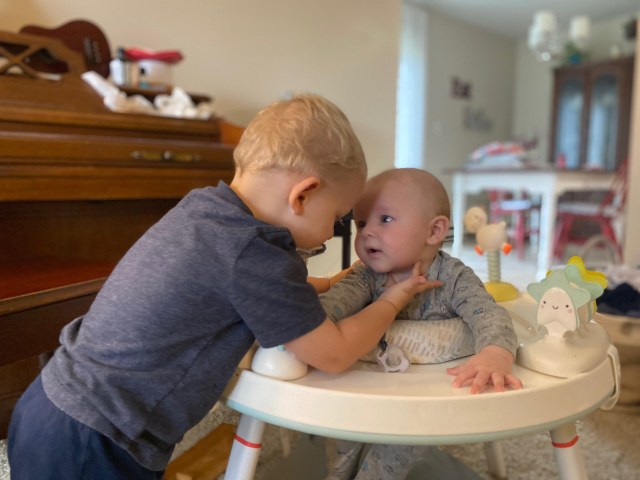
Two. The boys continue to be a supreme blessing to me in these days. I never realized the joys of love could run this deep, but they do with these two munchkins! They are beyond adorable. When asked what the days of the week are, Samuel says, “Monday, Tuesday, Papa, Thursday….” (Yes, we keep the boys on Wednesday) 😊 That makes me want to melt into a puddle of gooey milk chocolate on a hot gas stove. Below are a few recent pics. We get to host them for Thanksgiving dinner on Wednesday; otherwise, it’s a low-key weekend in our house, which is fine by me. Only after Thanksgiving do we start putting up Christmas decorations. That’s carved in stone, too. 😊 Next week we celebrate Samuel’s second birthday. 

Three. Speaking of stove, our kitchen renovation project is nearly complete. We’re just waiting on one final cabinet and the new backsplash. The transformation has been amazing. I can’t remember if I mentioned this before, but by securing and managing the subcontractors ourselves, and helping where we can, we’re saving about $20,000 over the estimate we received a couple years ago when we first started kicking the tires on this idea. Given the horrendous inflation over the past several years, that probably translates to about $25,000 today. Happy dance. Even though I can’t dance.

Four. My yearly Advent sob-fest has begun already. This one took me by surprise. I was doing some worship planning recently and wound up listening to the Tabernacle Choir’s rendition of “Lo! How a Rose E’er Blooming.” For some reason, it hit a tender spot, and the floodgates opened, perhaps because the load is quite heavy right now.

True man, yet very God,
From sin and death He saves us,
And lightens every load.

I’ll post the song below.

Five. COVID killed our wonderful choir, but I wouldn’t mind seeing it resurrected in due course, especially since our church is getting a new organ this week. (It’s a gently used though lovely Rodgers organ from Ephrata.) A few of us have been crawling around the organ chambers over the past several days, cleaning things out and getting ready for the new installation. We’re all a bit stiff and banged up from that venture, but I’m ecstatic that it will be operable in time for Advent and Christmas. I’ll also post our church’s Advent letter and lineup in case anyone is interested.

Six. My dissertation is trucking along, but it’s taking longer than it should. Even I—yes, I—am starting to drift into the “Let’s get this thing done, already,” mode. It’s just so tedious to write at this level and do a thorough job of engaging all the heavy hitters who’ve written on my topic over the past two millennia. At last count, I’ve gotten up to 19 languages, and that’s more than enough, don’t you think? Still, I love the research. It’s the academic writing (i.e., being precise, anticipating objections, making and defending an argument, documenting everything, etc., etc.) that’s so time consuming. All in good time, though, right?

Seven. By the time I publish this post, it will be November 22, 2023, the 60th anniversary of the assassination of President John F. Kennedy. I wasn’t born yet when that awful tragedy took place, but I became fascinated by all aspects of it when I was in elementary school. And, yes, I’ve done an awful lot of reading on this subject over the years, keeping up with old details and major developments in the case. I had hoped to write more extensively about it on this anniversary, but that’s just not possible this year. Maybe someday. What do I think happened? Let’s just say, “Things aren’t settled until they’re properly settled.” And this crime was never properly settled. Enough said?

Eight. In the spirit of JFK (who died on the same days as C. S. Lewis and Aldous Huxley), let’s end where we began—gratitude. It was President Kennedy who said, “We must find time to stop and thank the people who make a difference in our lives.” In my case, that would take a whole lot of time. And it would include you, the readers of TNL. Thanks for stopping by.

And Happy Thanksgiving to all. Be blessed.


Bonus:

Edit:

Oddly enough, today I’m thinking about the death of another larger-than-life personality, Princess Diana. Last night I finished watching episode 3 of the final season of The Crown, so it’s fresh on my mind. And it’s stirring up in me the loathing I already had for the media. I’m sitting here wondering if the paparazzi have learned their lesson, or if they’re still greedy, corrupt, and dangerous.

Holy Trinity Church in Oxford: Where C. S. Lewis Worshiped and Is Buried

The magic of England never fades for the true Anglophile. I posted earlier this year on our trip to The Kilns: Where C. S. Lewis Lived and Wrote, but I didn’t include pictures of Holy Trinity Church in Oxford, where Lewis worshiped and is buried. At long last, here are those pictures.

Our tour guide was a good friend of Lewis’s back in the day. He was also a Royal Air Force Veteran of World War II, which gave us plenty to talk about. We thanked him for his bravery and service, but he said it was the United States’ entry into the war that saved the world from the evil Nazi delusion. He had wonderful “Jack” Lewis stories to share that don’t usually make their way into the biographies and textbooks.

Lewis died at the Kilns on November 22, 1963, the same day as Aldous Huxley and President John F. Kennedy. Few people attended the Lewis funeral because they didn’t know he had passed. His brother Warnie went on a bender to soothe his depression, rendering him incapable of spreading the word. Moreover, the print and radio news cycles were dominated that week by the assassination of the American President. 

Lewis’ final years were happy ones. From charity and common literary interests grew a deep friendship with American poet and pen pal Joy Davidman. Her acquaintance with Lewis led to his underwriting the boarding school education of her sons David and Douglas. Eventually agape became eros for this charming if improbable couple, and they were married in 1956.

Joy was nearly 17 years Lewis’s junior, which only served to enrich the happiness of their marriage. Experience, enthusiasm, and an array of common interests combined to provide the needed chemistry. A savage case of cancer, however, cut short their life together. After several years of reprieve from an earlier and nearly fatal bout with cancer, Joy Lewis passed away on July 13, 1960.

Still, Joy’s entry into Jack’s life brought much happiness. As he wrote to one friend soon after their marriage, “It’s funny having at 59 the sort of happiness most men have in their twenties . . . ‘Thou hast kept the good wine till now.’ ” 

Lewis is buried beside his brother (who lived ten more years) in the cemetery of Holy Trinity Church, Headington Quarry, Oxford. His letters and books, and the lives these writings touch, are his enduring legacy.

The gravestone for Lewis and his brother, Major Warren “Warnie” Lewis, reads, “Men must endure their going hence,” the Shakespeare quotation on their father’s calendar the day their mother died. 

Oh, My Word, Part 3: Little Words and Big Ideas

Words have the power to captivate and communicate, sometimes even better than images do. That’s one of the reasons movie adaptations of our favorite books can fall flat. They deviate from what our own imaginations did with the words we read. Take, for example, this silly sentence from an unknown source: “The bulbous woman ballooned toward me.” No picture is needed for such a sight; the mental image conjured by the words is amusing enough.

Likewise, this famous line from Carl Sandburg needs no help from a video: “The fog comes on little cat feet. It sits looking over harbor and city on silent haunches and then moves on.” Such a scene can’t be filmed; it can only be conveyed by a creative and strategic use of words. Similarly, Truman Capote painted a feast of images with this memorable line: “Venice is like eating an entire box of chocolate liqueurs in one go.” I can almost taste the town just by reading the sentence.

My all-time favorite line in English comes from Alexander Pope’s description of Jesus turning the water into wine. The verse he crafted portrays the miracle performed in Cana in a rich and unforgettable way: “The conscious water saw its master and blushed.” 

Here the poet personifies the water, giving it a consciousness, the capacity to see, and the ability to feel embarrassed. The profound theological message conveyed in this one verse speaks volumes about the relationship of the creation to its creator (one of subordinate humility), as well as the exalted identity of the one who performed the miracle (the creator himself, incarnated and living humbly as a craftsman in Galilee). Can a picture do all that? Probably not.

I happen to love words, and I enjoy learning new ones. I also love reading the works of others who use them better than I do, sharpening my own craft in the process. I was an English major in college, so I had the opportunity to read broadly across the literature spectrum. Anchored now in the truths of a biblical worldview, I’m untroubled by reading works outside my own tradition. It expands my perspective and allows me to peer into how other people think and use words. 

I also enjoy the weekly challenge of crafting a “big idea” for my sermons, encapsulating the entire message in a single sentence. Vivid, pithy language with turns of phrases and symmetrical touches can serve the homiletical task well. There’s no shortage of good examples on how to do this.

“Ask not what your country can do for you; ask what you can do for your country.” (President John F. Kennedy)

“Do I love you because you’re beautiful? Or are you beautiful because I love you?” (Oscar Hammerstein)

“In the blue grass region, a paradox was born: the corn was full of kernels, and the colonels full of corn.” (John Marshall)

“I’d rather have a bottle in front of me than a frontal lobotomy.” Steve Allen (though variously attributed)

Factor in the gospel, and there are all kinds of possibilities when it comes to words that evoke vivid images and big ideas. Who can forget the Rev. Dr. Martin Luther King’s “I Have a Dream” speech at the Lincoln Memorial? Over time his big idea became the title of his message. As Winston Churchill once said, “If you have an important point to make, don’t try to be subtle or clever. Use a pile driver. Hit the point once. Then come back and hit it again. Then hit it a third time—a tremendous whack.” Dr. King did exactly that.

Good communicators get this. Andy Stanley writes, “Every time I stand to communicate, I want to take one simple truth and lodge it in the heart of the listener. I want them to know that one thing and know what to do with it.” Finally, as if to model the very technique he advocated for so many years, Haddon Robinson said, “A sermon should be a bullet, not buckshot.” Here are some big idea bullets I’ve fired recently on Sunday mornings:

Hope never dies because the God of the impossible lives.

To outlive your life, yield it completely to the Author of life.

Many babies have become kings, but only one king has ever become a baby.

When God stretches your faith, he will also strengthen your heart.

Love God not to get him to love you but because he already does. 

The activation of God’s promise is joined to the asking of God’s people.

If you’re wandering around in a spiritual desert, you need to have a moral compass.

A fake gospel cannot deliver a real salvation.

The grace of God will remove sin, but it will not redefine sin.

Finite human beings are like crossword puzzle addicts with a limited vocabulary.

The big idea of the biblical text must always be located within the Big Story of the biblical plot, lest the forest be missed for the trees. (Big ideas and big stories need each other.) For this reason, I read both exegetical and hermeneutical materials. I do this out of enjoyment but also out of a sense of calling to “tell the people the full message of this new life” (Acts 5:20), as described in a previous post. For me it’s a labor of love.

But sometimes my words are not vehicles of love—toward God or toward others. Too often they’re self-centered or dispiriting. Too often they’re unhelpful or unkind. That’s why this is yet another area where I need to keep making progress. Specifically, I need wisdom, power, and grace from God to eradicate my complaining and eliminate my criticism—even when such impulses remain unarticulated. They’re still under the surface.

How can I properly handle God’s words in Scripture if I continually mishandle my own words in life? The incongruity is a red flag. As Marilyn McEntyre writes, “What is our task as a logocentric people if not to cherish the word? God, who became, as Eliot so beautifully put it, the ‘word within a word, unable to speak a word,’ has put a measure of God’s own power into our hands and on our tongues. May we use it to good purpose.”[1]

On those occasions when I become a “negaholic” or a “complainiac,” I’m not using the power God gave me to a good purpose. More on these two verbal vices next time.

Image Credits: krqe.com, wallpapercave.com; cultivatingethos.org.


[1] Marilyn McEntyre, Caring for Words in a Culture of Lies (Grand Rapids: Eerdmans, 2009), 21.