Excellence in Exile, Part 3: Divine Wisdom for Struggling Neighbors (Daniel 2:1-30)

While in Babylon, Daniel and his three friends walk the same tightrope every believer has to walk today in a fallen world—avoiding isolation on the one hand, and avoiding assimilation on the other. They did it well. In fact, in Daniel 2 these remarkable Jewish teens continue living out the command God previously gave the exiles—to live for the good of a bad city (Jeremiah 29:4-7). They did this by serving their unbelieving neighbors and helping them flourish.

In many ways, Daniel 2 gives us a collision between the wisdom of this word and the wisdom of God. Nebuchadnezzar is the portrait of a man who faces life with worldly wisdom. Daniel, however, is the portrait of a person who faces life with godly wisdom. Quite significantly, this collision is not a fistfight. It’s not a heated debate. It’s not a military battle. It’s a ministry.

Specifically, Daniel has a ministry to a man in crisis. And in that ministry to his royal neighbor, the wisdom of God is displayed. The lesson for us today is instructive: God’s faithful people can help connect faithless people to God.

Nebuchadnezzar’s problems are not unlike our neighbors’ problems today. For example, some of our neighbors may be consumed with worry, anxiety, and insecurity (v. 1). Some may seek professional help for their deepest troubles (vv. 2-4). Some may become suspicious of the world’s best experts (vv. 5-9). Some may hear the world’s experts admit their own limitations (vv. 10-11). Some may grow increasingly insecure and perhaps even violent (vv. 12-13). 

Daniel’s ministry to the king is anchored in his knowledge of who God is. Indeed, he has a lofty view of Yahweh, which is helpful to God’s people today when we seek to help our neighbors who are in crisis. Specifically: 

  • Because God is gracious, his people can approach a neighbor’s crisis with wisdom and tact (vv. 14-15).
  • Because God is missional, his people can view a neighbor’s crisis with a sense of divine purpose (v. 16).
  • Because God is all-knowing, his people can take a neighbor’s crisis to him in prayer (17-19a).
  • Because God is sovereign, his people can praise him in the midst of any crisis (vv. 19b-23).
  • Because God is revealing, his people can offer wisdom for a neighbor’s crisis when needed (vv. 24-28a).
  • Because God is good, his people can serve neighbors in crisis even if they believe differently (vv. 28b-30).

By the time Nebuchadnezzar leaves the stage in the book of Daniel, he comes to recognize that Yahweh is the Most High God of the universe. May that likewise be the result of our ministry to the people around us today.

Sermon Resources:

Series: Excellence in Exile: Faithful Living in a Fallen Land (Daniel)

Contact This New Life directly for the sermon audio file.

The Serious Business of Laughter

As the middle child of three, I totally get this!
Samuel comes to mind. He’s always too excited at our house to go to sleep, even when he’s exhausted.
Good one. On the other hand, what do you think all that kicking was about?
Raw carrots, yes. Cooked carrots, meh.

Yeah, these are kind of juvenile, but I needed a good laugh today. We did the best we could this past year during Sara’s heart-wrenching illness, and then we did the best we could to support and resource those on the front lines of both her public and private services. (I was happy to take a behind-the-scenes role and let others use their gifts to lead the memorials.) The healing work goes on, though, so we need some relief points along the road ahead.  

One of my favorite Sara memories is when I was cracking up during a late-night chew-the-fat session at our house last year, and she started narrating the various sounds and gestures of my laugh while I was in the very act of laughing. That just made me laugh all the more. And the memory of it is making me laugh today, too. So, thank you, Sara! 🙂

Does it really need to be said that pastors are just ordinary people like everybody else? We have our own set of struggles while simultaneously serving as the repository of other people’s pain. It can be unrelenting sometimes. And it hurts.

The last time I led a congregation through the path of deep grief after a similar tragic death, I was soon plunged into the dark world panic attacks and depression myself. Thank God in time he “lifted me out of the slimy pit, out of the mud and mire; he set my feet on a rock and gave me a firm place to stand” (Psalm 40:2). He can do the same for you.  

In the meantime, try to laugh a little. It can be medicine for the soul (Proverbs 17:22).

Bonus:

Get it? 🙂

Then You Also Will Appear with Him in Glory

Since, then, you have been raised with Christ, set your hearts on things above, where Christ is seated at the right hand of God. Set your minds on things above, not on earthly things. For you died, and your life is now hidden with Christ in God. When Christ, who is your life, appears, then you also will appear with him in glory.
Colossians 3:1-4   

And I heard a loud voice from the throne saying, “Now the dwelling of God is with men, and he will live with them. They will be his people, and God himself will be with them and be their God. He will wipe every tear from their eyes. There will be no more death or mourning or crying or pain, for the old order of things has passed away.” He who was seated on the throne said, “I am making everything new!” Then he said, “Write this down, for these words are trustworthy and true.” 
Revelation 21:3-5

Beautiful, Brilliant, and Broken

I’ve lost count of the number of Shakespeare festivals and other productions we attended together over the years, but they were one of the highlights of our friendship—along with rich conversations about theology, art, and literature well into the night (and sometimes well past midnight). The Braveheart Highland Pub in Hellertown was a favorite pre-show dining spot of ours.

In the final ten months of her life, Sara’s mental illness plummeted faster than I had ever seen in anyone else her age. No amount of counseling, encouragement, therapy, medication, prayer, or hospitalization could help. And she received the best available in each case, albeit too late. It wasn’t merely depression that took her from us but schizoaffective disorder in all its ugliness. It was a heartbreaking tragedy we watched unfold before our very eyes.

Yet we are persuaded that God met that tragedy with his abounding grace. We who gathered to discuss her services (and the difficult ministry to those who remain behind to deal with deep grief) concurred that nothing could separate her from the love of God that is in Christ Jesus (Romans 8:38-39). Her love for the Lord was genuine and not undermined at all by her aggressive illness. Indeed, the Lord is near the brokenhearted (Psalm 34:18). He is near to us, too.

Best of all, when you know Christ by faith as your Lord and Savior, what puts you in the grave can’t keep you in the grave.

So, in that spirit, I bid farewell in hope:

“Goodnight sweet prince[ess],
And flights of angels sing thee to thy rest.”
Hamlet, Act V, Scene 2

Why the Unicorns Died Off

Maybe Noah got drunk earlier in the story than we realized.

Can you hear the night’s deep song?
All the shadows say
Telling you when you’re asleep,
Tears will fade away
Dream of morning’s golden light
When you and I will leave the night … 

And when the moon is high and bright,
Stars will shine on you 

Dream of morning’s golden light
When you and I will leave the night … 

Make a wish and when you close your eyes
I will come to you 

Dream of morning’s golden light
When you and I will leave the night … 

Make a wish and when you close your eyes
I will come to you

Samuel and the Joys of Onomatopoeia

It’s commonly known that onomatopoeia refers to a word that phonetically imitates or suggests the source of the sound it describes. For example: 

The snake hissed in the grass.  

The fallen leaves rustled in the wind.  

The bees buzzed around the flower. 

The students murmured their dissatisfaction about the upcoming quiz.  

The rooster’s cock-a-doodle-do announced the arrival of a new day.  

“Chitty bang-bang. Chitty-chitty bang-bang.” (Ian Fleming)  

“Plop, plop, fizz, fizz. Oh what a relief it is.” (Paul Margulies & Tom Dawes)  

The Scriptures contain examples of onomatopoeia, too, though it doesn’t always come through in English. For example: 

“Then thundered the horses’ hoofs—galloping, galloping go his mighty steeds” (Judges 5:22). Hebrew: daharoth, daharoth (cf. English: The Lone Ranger: darrrunt, darrrunt). 

“Be silent before the Sovereign LORD . . .” (Zephaniah 1:7a). Hebrew: hass (cf. English: hush). 

“Your wife Sarah will bear you a son, and you will call him Isaac” (Genesis 17:19b). Hebrew: Yitzhak (cf. English: yuk yuk). 

“Go and buy a clay jar from a potter” (Jeremiah 19:1b). Hebrew: baqbuq (cf. English: glub glub). 

“And some began to spit on him . . .” (Mark 14:65a). Greek: ptuo (cf. English: spit). 

It’s a fun linguistic phenomenon.  

Anyway, Samuel discovered its joys recently when he started imitating the siren of a little firetruck we recently bought him.  

“Eee-ooo-eee-ooo-eee-ooo!” 

He also displays a bit of rhythm, too, with the bopping head. This little munckin always makes my heart smile. 

Some Bonus Snaps

Fifty Years Ago Today

August 22, 1973

An unknown little girl

in an unknown little church

in an unknown little town 

confessed her need for a Savior.  

Christ Jesus scooped her into His arms, swallowed up her brokenness, and made her a child of His kingdom.

She is known and loved by the God of the universe. 

I am that girl. I will never get over it. I never want to.

    – Sonya

    Excellence in Exile, Part 2: Cooperation without Compromise (Daniel 1:3-21)

    Believers are resident aliens in this world. Three times in 1 Peter, the followers of Christ are called “strangers” or “aliens.” The Apostle Paul concurs, reminding the Philippians that their “citizenship is in heaven” (Philippians 3:20). In other words, the believer’s primary residence is not planet Earth. Someday we’re going home to a world of heavenly perfection.  

    As great as that truth is, it creates a challenge for the people of God. How do we interact with the world while we’re here? What is our relationship to unbelievers supposed to be until we finally go home? This issue has always been a struggle for the covenant community. 

    When Daniel and his three friends were aliens in Babylon, they faced a similar challenge. They discovered quickly that the art of being a believer in this world is to love God and love your neighbor—in that order. King Nebuchadnezzar tried to shape their thinking, their identity, and their convictions. But the four teens from Israel resisted a secular brainwashing at Babylon University. They refused to allow themselves to be intoxicated by the glamour that comes from eating at the king’s table while trying to guard their own hearts against personal compromise. They survived in a culture that was hostile to their faith by drawing some lines in the sand and refusing to cross them. 

    But there’s a way to draw those lines and a way not to draw them. Daniel didn’t lead a march, a sit-in, or a protest rally. He didn’t engage in hate speech. He didn’t walk around Babylon with a placard saying, “Thou shalt not eat non-kosher food,” or “Prepare to meet thy God.” Instead, he practiced cooperation without compromise. Daniel was sympathetic to the king’s official and didn’t want him to lose his head because of his faith. So, Daniel wound up cutting a deal—and it was a deal that God honored. 

    One can’t help noticing that Daniel had a genuine respect for the unbelievers around him. He wasn’t a religious snob with a holier-than-thou chip on his shoulder. There was an ease with which he moved in secular circles. He wasn’t edgy around people who didn’t share his faith. He wasn’t uncomfortable around people who worshiped idols. He didn’t treat them like they had spiritual cooties. Rather, he was kind and deferential to them. He also accommodated them—but only in so far as his own faith would allow him to do so. God was always his first loyalty. 

    Jesus, of course, was the ultimate resident alien. He didn’t arise from within the human race; he came from outside it. That’s what Christmas is all about. In his life and ministry, Jesus was totally loyal to his heavenly Father. He never compromised, and he never sinned. Yet he moved freely and easily among the people who were far from God, leading them to see more clearly his truth and love for everyone.In his death on the cross, Jesus became alien-ated by bearing in his own body the sins of the world in himself. He did that so that everyone could become undefiled by faith, and believers could someday go back home with him.

    Sermon Resources:

    Series: Excellence in Exile: Faithful Living in a Fallen Land (Daniel)

    Contact This New Life directly for the sermon audio file.

    The World’s Most Impressive Fall Color Destinations

    “As the hot, sticky hug of summer yields to the crisp embrace of autumn, nature embarks on a colorful and captivating transformation. Fall is our favorite.” So write the editors at the captivating Moss and Fog website, and I wholeheartedly concur. Fall is magical. I’ll be linking below to their August 17 post titled, “Exploring the World’s Most Impressive Fall Color Destinations.” First a few snaps and clips of my cherubs.

    Levi cooing to Mama.
    Samuel enjoying the special seat I got him for his new wagon.
    Someone learned how to use the remote to our patio lights.
    Testing. Testing. Testing.
    He pushes a button and then announces the color.
    Bubby always gets worn out after a day of playing with Papa.

    O.k., here’s the link to that Moss and Fog post.

    Little Ones to Him Belong

    Samuel is only 19½ month old, but yesterday he joined his mama on the chorus of “Jesus Loves Me” at bedtime, and it took my breath away. His singing is beyond adorable, and my heart may have melted into a big fat puddle of Papa-love when I heard it. The video clip was shot after the lights went off, so there’s nothing to see. But there’s plenty to hear—pure praise “out of the mouth of babes.” Could there be any sweeter or more important message than: 

    Jesus loves me, this I know, 
    for the Bible tells me so. 
    Little ones to him belong; 
    they are weak, but he is strong. 

    Yes, Jesus loves me.
    Yes, Jesus loves me. 
    Yes, Jesus loves me.

    The Bible tells me so. 

     💙 🙌💙 🙌💙 🙌💙 🙌💙 🙌

    Nothing to see but plenty to hear.
    Samuel picked up all his toys, so he was allowed to watch a little TV.
    Levi is laser focused on those who came to see him.

    Excellence in Exile, Part 1: Living for the Good of a Bad City (Psalm 137:1-9; Jeremiah 29:4-14; Daniel 1:1-2)

    Spiritually speaking, much has changed in America during our lifetime. From a Christian perspective, some of these changes are sad, revolting, depressing, and even scary. As a nation, we’re far from God, and the church at large is in a funk because of it. Older evangelicals especially can’t believe the changes they’ve witnessed. It is depressing. Like Israel in exile, we’re tempted to lament the situation, curse the darkness, and “hang up our harps on the poplar” (Psalm 137:2). But while these reactions are understandable, it’s vital to remember that God has a plan for his people even in spiritually dark times. Especially in dark times. 

    Jeremiah 29:4-11 provides some much-needed encouragement. This famous passage of Scripture is often ripped from its context, but the context is vital to understanding its message and contemporary relevance. The “plans” that God has for his people are not individual recipes for success, but plans for effective corporate witness and an eventual end to the exile. “But until then,” says God, “don’t run from the pagan culture; settle down in it. Live among your neighbors and love them. Help them flourish. Seek their welfare. Live for the good of a bad city.” 

    In other words, his marching orders for believers are to live out the wisdom of God in their neighbors’ midst, captivating them with the reality of who God is. The unbeliever’s eternal destiny is God’s business, but the believer’s business is to be a good neighbor and stay loyal to God in the process. It’s to be in the world but not of it. 

    And because God is “beautifully sneaky,” he’s always up to something good in the midst of something bad. Magi attended the birth of Christ precisely because the nation of Israel went into exile. Had the covenant people stayed in their familiar and comfortable land, the messianic prophecies never would have reached the Gentiles. But they did, and that’s likely how the Magi knew to connect the astronomical phenomenon with the birth of the new king. God’s love is truly for the whole world. 

    And so it is today. It’s the scattered church that can plant seeds for the harvest. When a culture is spiritually dark, God’s people can graciously turn on the light. That’s part of what it means to be “excellent in exile.” The book of Daniel shows us how.

    Sermon Resources:

    Series: Excellence in Exile: Faithful Living in a Fallen Land (Daniel)

    Contact This New Life directly for the sermon audio file.

    Two Little Dino-Mites

    Samuel likes being a big brother to Levi. We had them over to our place a couple times this week, which is always a sheer delight. The last time they were here, they had on matching dinosaur shirts. Of course, I had to get the camera. 😊 Levi had a procedure at CHOP this week, and all went well. He seems rather peaceful, with no lingering effects. 

    This time of year is always thick with course and syllabus preparation, which also comes with added tasks and responsibilities in the digital age. Still, it’s a labor of love, as is the dissertation, which is still in motion. Next month always feels like a changeover at church, too, so the pile is doubly high these days. All the more reason to throw in some silly memes for a few lighthearted moments before getting back to the grind.

    Enjoy. And have a fantastic weekend.


    The cats don’t even try.
    This is never more true than when I try to swim or play softball.
    As long as it’s not a lead pencil.
    A legitimate observation, despite the typo.
    I guess this qualifies as a generation gap.
    Passed the test at school. Flunked the test at home.
    Yes, I am an INTJ, but my N is moving in the F direction these days. In fact, I tend to extrovert my F, which is why I could never be a good poker player.

    A New Red Wagon for the Boys

    Last week I got a new red wagon for the boys that I can hook up to my lawn tractor. It’s our own little Knoebel’s ride—with no tickets necessary (though my next door neighbor offered me two bucks for a ride. Unfortunately, he couldn’t fit)!

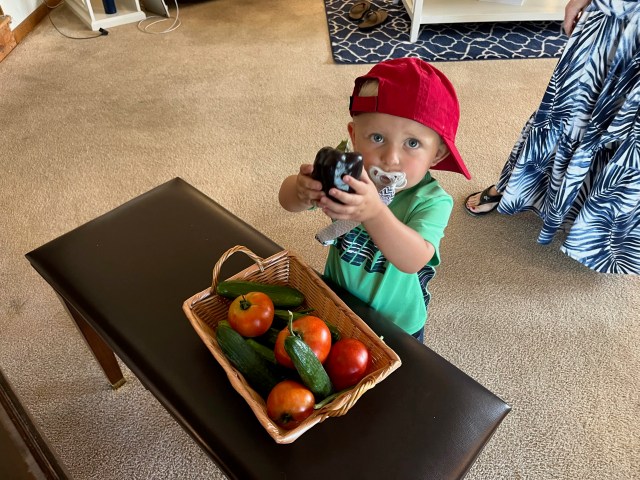
    Samuel likes the wagon, though he doesn’t really like the noise that comes from the tractor. We did several laps around the yard, and then I dropped him off at the garden, where he loves to help us pick the ripe stuff. As we love to say around here, “He’s the best Bubby ever.”  

    Levi is becoming more alert and used to our voices. It was fun to feed him for the first time last week and sing him to sleep. He is so precious, and Samuel is (mostly) gentle with him.

    Bouns

    A Glimpse of Glory (Luke 9:28-36)

    All three Synoptic Gospels feature an account of the transfiguration of Jesus—that moment where Christ appears in a radiant, glorified state alongside Moses and Elijah. While John doesn’t give us the story per se, he does refer to it. Speaking of Jesus he writes, “The Word became flesh and made his dwelling among us. We have seen his glory, the glory of the One and Only, who came from the Father, full of grace and truth” (John 1:14). Despite having the outward form and appearance of a mere man, Jesus in his very nature and essence is simultaneously divine. He is deity dressed in a human body. 

    Jesus no doubt received great encouragement from this heavenly event as he faced the cross, but it was primarily a revelation for the sake of the disciples. They needed to be prepared for the dark days ahead—days that would feature the rejection, conviction, and brutal execution of their leader. The voice from heaven assured the disciples that Jesus was indeed the Son of God, as it had once assured John the Baptist at the Jordan (Matthew 3:17) and would again assure the multitude in Jerusalem (John 12:28).  

    The Gospel writers came to see in this Christophany a preview of resurrection glory—both for Jesus and for his followers. In Jesus we see a glimpse of the glory to come. As the Apostle Paul writes, “For you died, and your life is now hidden with Christ in God. When Christ, who is your life, appears, then you also will appear with him in glory” (Colossians 3:3-4).

    Sermon Resources:

    Contact This New Life directly for the sermon audio file.

    A Walk to Remember

    C. S. Lewis engaged in a life-changing conversation with Hugo Dyson and J. R. R. Tolkien on Saturday, September 19, 1931. The conversation took place on Addison’s Walk, a footpath around a small island in the River Cherwell on the grounds of Magdalen College, Oxford, England.  

    As a boy, Lewis loved the Norse tales of a dying god. As a man, he grew to love and appreciate the power of myth throughout the history of literature. But he didn’t believe them. Beautiful and stirring though they may be, they were, he concluded, ultimately untrue. As he famously said to Tolkien, myths are “lies and therefore worthless, even though breathed through silver.”  

    “No,” said Tolkien. “They are not lies.” His point was that the great myths reflect a fractal of the true light. They derive from “primary art,” and they come from creators who themselves were created. In other words, within any good myth lies a glimpse of eternal truth, the Christian Story. They talked on, and Lewis became convinced of the merit of Tolkien’s argument.  

    I pulled out my phone and watched the following video clip while walking the same path in the spring of 2019. Knowing the far-reaching impact this conversation has had—including on me—I prayed a simple prayer of thanksgiving—through tears, of course—for how God used this conversation to change the course of history. Including mine.

    For more on this topic, see my previous post, “Beauty and the Beast on Broadway (and the Bible).” 

    Photo Credit: Miles Underwood (Wikimedia Commons)

    Bonded for Life (1 Samuel 18:1-4; 2 Samuel 9:1-7)

    David and Jonathan enter into a parity covenant, exchanging robes and weapons to signify their life-long bond of loyalty to each other. The covenant they cut includes Jonathan’s young son Mephibosheth, whom David seeks out to bless even after Jonathan dies. Thereafter, Mephibosheth is invited to eat at the king’s table forever, unworthy though he may be. David shows Mephibosheth hesed (loving-kindness) because of his covenant with Jonathan, who served as his son’s covenant representative head. 

    This historical episode illustrates well the concept of representation. As Jonathan was Mephibosheth’s covenant representative head, so Jesus is the covenant representative head of the entire human race. Moreover, like David looking for Mephibosheth, God is searching for us, wanting to lavish upon us all the riches and blessings that come from being in covenant with him through Christ. He invites us to eat at the King’s table forever, unworthy though we may be. God’s hesed (lovingkindness) now flows to all who acknowledge Jesus by faith as their covenant representative head.

    Sermon Resources:

    Contact This New Life directly for the sermon audio file.